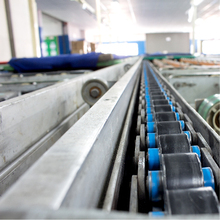
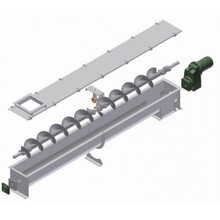
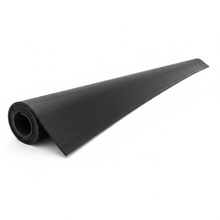
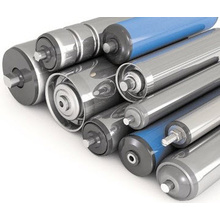
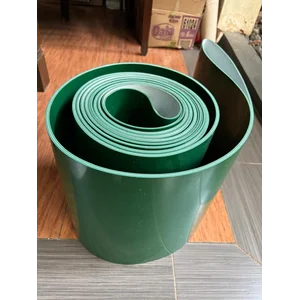
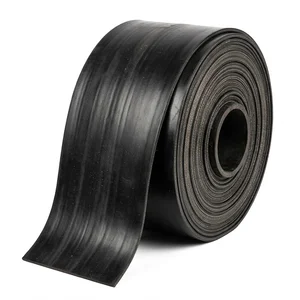
PVC Conveyor Belt Industrial PVC Conveyor Belting for Material Handling and Product Transportation Systems
View DetailsRequest a quote
The supplier does not display a price for this product. Click Request Quotation to get the best price.
Explore a wide selection of Belt Conveyor.
Ceramic Pulley Lagging Services from PT Hastin Multi Teknik delivers specialized high-alumina ceramic tile application on conveyor pulley shells. Our service scope covers initial shell metal inspection, metal surface preparation via abrasive grit blasting to SA 2.5 standards, metal primer and two-component cold bonding adhesive application, precision rubber-backed ceramic tile sheet installation, heavy stitcher rolling to eliminate air voids, and final adhesion strength verification. Explore our full range of service offerings in our pulley lagging and refurbishment service catalog.
Ceramic lagging is strongly recommended for heavy-duty drive pulleys, overland conveyors, and high-tension material handling systems exposed to severe sliding abrasion and slurry conditions. High-alumina ceramic tiles embedded within an elastic rubber substrate matrix provide high friction coefficients and wear resistance many times greater than standard rubber lagging, ensuring zero belt drive slippage under extreme operating conditions. Our field technicians execute ceramic lagging directly on site at your facility or inside our workshop center across Indonesia.
The table below presents the global service attributes and technical scope parameters for ceramic pulley lagging operations:
| Service Attribute | Technical Work Details |
|---|---|
| Final Service Name | Ceramic Pulley Lagging Services |
| Group & Service Type | Pulley Services - Ceramic Pulley Lagging (High-Alumina Tile) |
| Service Mode | On-Site (Customer Facility) and Workshop |
| Commercial Unit | Pulley (Per Pulley Unit) |
| Ceramic Grade | High-Alumina Ceramic (92% to 95% Al2O3 content) |
| Ceramic Tile Pattern | Dimpled (raised studs for traction) and Smooth (flat for wear protection) |
| Ceramic Coverage | 30%, 40%, 50%, up to 80% surface area (configured to drive load) |
| Rubber Substrate Matrix | High elasticity natural/synthetic rubber featuring integrated CN bonding layer |
| Total Lagging Thickness | 12 mm, 15 mm, 20 mm, up to 25 mm |
| Handled Pulley Types | Drive pulleys, head pulleys, snub pulleys, bend pulleys, take-up pulleys |
| Bonding System | Two-component cold bonding adhesive and dedicated waterproof metal primer |
| Surface Preparation | Abrasive grit blasting (SA 2.5), mechanical grinding, & solvent degreasing |
| Rubber Base Hardness | 60 Shore A to 65 Shore A (shock-absorbing durometer) |
| Manpower | Pulley lagging supervisors and certified ceramic lagging technicians |
| Safety Procedures | Full PPE, LOTO systems, Permit to Work (PTW), Working at Height permits |
| Quality Control (QC) | Shell inspection, tile alignment check, bonding test, edge inspection included |
| Documentation | Service reports, inspection reports, photo documentation included |
| Service Area | All regions across Indonesia |
Applying Ceramic Pulley Lagging provides long-term technical advantages for high-capacity conveyor drive systems:
We apply industrial-grade ceramic tiles and rubber substrate materials designed for severe operating environments:
For technical guidelines regarding pulley maintenance and lagging practices, explore our pulley lagging and refurbishment service articles on our resource portal.
Ceramic tile lagging application follows structured technical stages to guarantee homogeneous adhesion:
Ceramic Pulley Lagging Services applies effectively across heavy bulk material handling sectors:
Flexible service modes adapt smoothly to your plant shutdown schedules:
Strict workforce safety protocols govern every lagging installation:
The table below summarizes technical corrective actions for potential lagging operational issues:
| Operational Issue | Root Cause | Technical Corrective Action |
|---|---|---|
| Ceramic Tile Debonding | Incomplete primer coverage or heavy shock impact exceeding substrate capacity. | Strip damaged tile sections, re-clean steel, and execute cold adhesive spot tile replacement. |
| Rapid Belt Cover Wear on Non-Drive Pulley | Installing dimpled ceramic tile patterns on non-drive pulley positions. | Re-lag shell applying smooth ceramic tile patterns or smooth rubber sheets. |
| Air Void Formation Under Substrate | Insufficient stitcher roller pressure during ceramic sheet layup. | Inject specialized adhesive into air voids and compress firmly with mechanical rollers. |
| Reduced Adhesion Strength | Adhesive application executed during high atmospheric humidity. | Re-prepare metal surfaces and re-apply lagging under controlled environmental conditions. |
PT Hastin Multi Teknik is your trusted partner for material handling engineering solutions. Learn more on our PT Hastin Multi Teknik company profile page.
Our professional services include:
To accelerate official quotation processing, please include the following data parameters with your RFQ through the PT Hastin Multi Teknik contact service:
Why is Ceramic Pulley Lagging the preferred choice for heavy-duty Drive Pulleys?
High-alumina ceramic tiles provide extreme wear resistance and high friction coefficients, eliminating drive slippage on high-capacity conveyor systems.
What is the difference between Dimpled and Smooth ceramic tile patterns?
Dimpled tiles feature raised studs to grip drive belts, while smooth tiles present flat surfaces to protect non-drive pulleys without cover scuffing.
What is the expected operating life of Ceramic Pulley Lagging?
Alumina ceramic lagging generally lasts 3 to 5 times longer than standard rubber lagging under identical operating conditions.
Does PT Hastin Multi Teknik provide warranty coverage for lagging adhesion?
Yes, adhesion warranty coverage aligns with contract terms and joint inspection sign-offs before final handover.
Can't find the product you're looking for?Request a quotation now
 View Details


Click the number to contact the supplier directly